



Sadly, there is not a day at 4KIDS – the ministry that launched HopeConnect™ – when we aren’t walking alongside a child who has been removed from their home due to neglect or who is being impacted by challenges within their family. The outcomes of these experiences are heartbreaking.
In Part 12 of our Resilience Series, we want to help you better understand how neglect and family challenges impact a child’s life, while also offering you seven practical strategies to help your child heal, overcome, and apply the all-powerful Hope of God’s Word in their lives.
Neglect and Its Effects
Neglect is the most common form of child maltreatment, and it occurs when a child’s basic needs are not adequately met. These needs can include:
- Physical needs (consistent access to food, safe shelter, and appropriate supervision)
- Medical needs (access medical, dental, and mental health care)
- Educational needs (support for attending school or adequate homeschooling),
- Emotional needs (affection, nurture, emotional support)
It is important to note that poverty itself is not neglect. While poverty can place a lot of stress on families and sometimes increase the risk of a child being neglected, many parents living in poverty care deeply for their children and work hard to meet their needs.
In many cases, parents that are neglecting their children are physically with them in the home but may be overwhelmed, unsupported, dealing with significant stressors, untreated mental health conditions, or substance use challenges. Children do not have to be physically abandoned to be neglected, but neglect will feel like abandonment to the child.
The effects of neglect are overwhelming to a child and include learning difficulties, attention problems, difficulty with self-regulation, and low self-esteem. These children may be behind their peers academically and have difficulties focusing in school because their other basic needs are not being met. They may seem anxious and withdrawn and have difficulty forming attachments.
Family Challenges & Their Effects
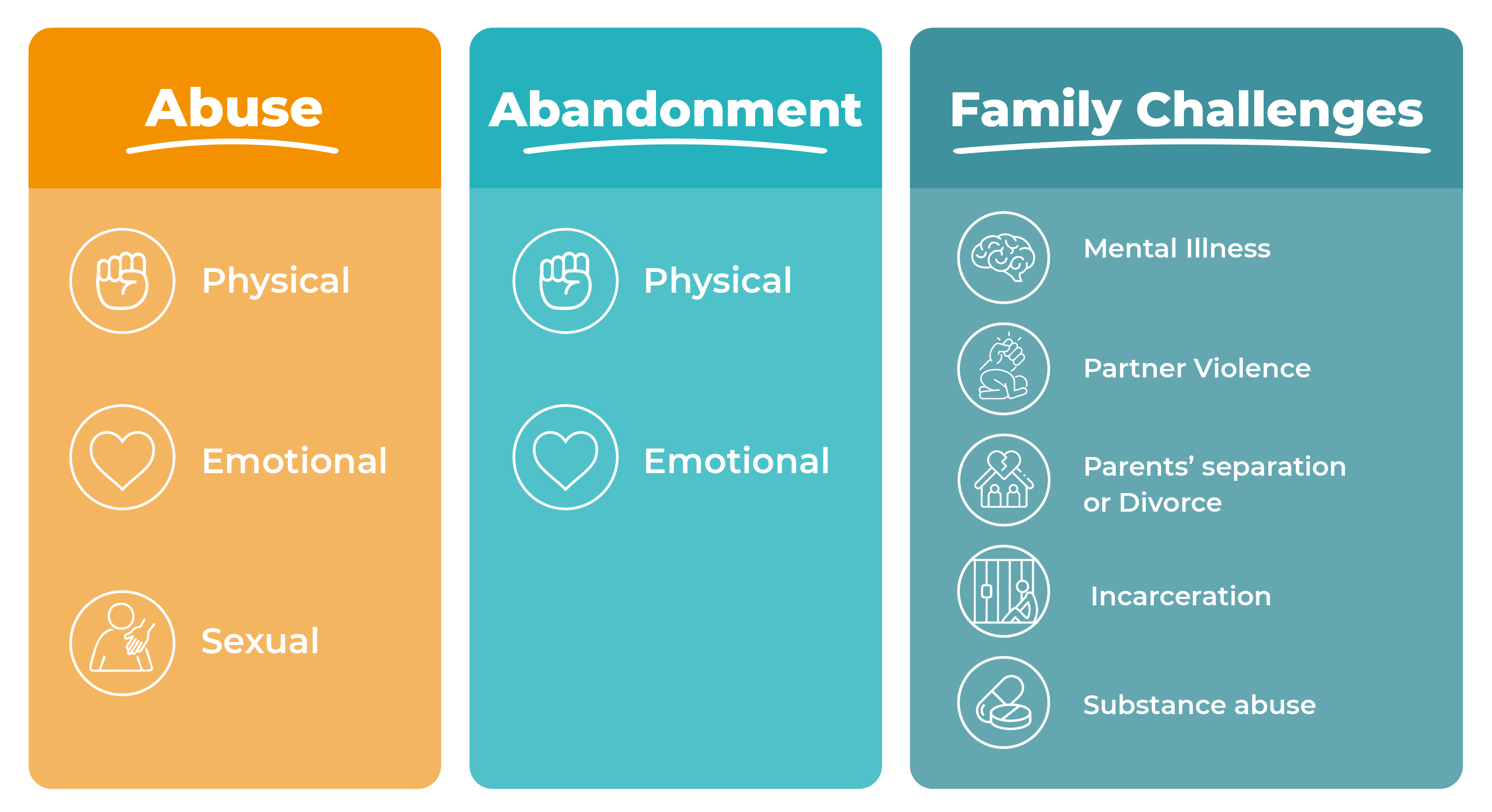
In many cases, neglect occurs because of challenges in family that make it difficult for a caregiver to consistently meet a child’s needs. Some examples of those challenges are:
Mental illness
When a primary caregiver has an undiagnosed or untreated pervasive mental disorder, children are at risk of not getting their needs met or having inconsistent care. There are different cultural views on addressing mental illness that can act as a barrier to treatment. Some mental disorders can be hereditary and passed down, so if the disorder is never acknowledged, the child may also not receive the necessary interventions.
Domestic violence
Domestic violence is one of the most common factors that leads to children being removed from their homes. Living in a violent home often places the non-offending caregiver in survival mode, making it harder for them to consistently meet their child’s needs; not because they don’t care, but because they themselves are navigating danger, stress, and uncertainty. There is also an increased risk that violence between intimate partners may later be directed towards the children.
Divorce or Separation
The change from a two-parent to a single-parent home can create significant stress on the family system. There is a loss of income that may affect the family economically and their standard of living. The single parent may experience feelings of grief from divorce or separation and feel overwhelmed raising children without a partner.
It is also important to acknowledge a well-documented risk factor: children may be more vulnerable to harm when a caregiver’s new partner or another adult in the home has access to the child but does not have a biological or long-standing attachment to them. While this is not true in every situation, it is one reason why careful supervision, boundaries, and awareness are essential when new adults enter a child’s daily environment.
Substance Abuse
A parent addicted to substances is often physically and emotionally unavailable to their child. The parent is compromised and inconsistent and often in denial about the extent of their problem and the subsequent effects on their child. This often leads to poor decision making and financial management and placing children in unsafe environments and situations.
Imprisonment
Short or long-term incarceration of a caregiver can disrupt the family unit. Children may feel abandoned by a significant figure in their lives, often without understanding or appropriate explanation of the circumstances. The remaining parent may suffer from grief and loss of a partner and is left to face the financial impact and the burden of raising a child alone. Children with an incarcerated caregiver may show signs of anxiety, sadness, confusion, or behavioral changes as they try to make sense of the separation. They may also struggle with stigma or shame, which can further complicate their healing process.

Healing & Real, Lasting Hope
The effects of neglect and family challenges can be severe. Yet, there is the real and lasting hope in Christ that is an anchor to the soul and hurting heart of a child in crisis. And you, mom, dad or caregiver can instill this Hope to help your child heal and recover.
Remember, in this series we learned that resilience can grow even in the midst of adversity. God is a redeemer and a restorer. He knew your child when they were knitted in their mother’s womb, and has a plan for your child, to give them a future and a hope.
Here are six practical strategies you can deploy to be ways yo be the hands and feet of God to help your child strengthen their resilience and experience restoration.
- Speak Hope: Share God’s Word with your child. HopeConnect™ Everyday Moments activities always end with a faith-filled prayer and the affirming Hope of God’s Word you can use to help your child experience God’s restoring power in their young life.
- Show Consistency: Consistently meeting your child’s most basic needs by providing a home, food, education, and medical care is already helping your child to heal. Predictable environments and consistent routines help to reduce stress and anxiety and promote trust.
- Respond with Empathy: Responding warmly and consistently, listening to your child, and validating and normalizing feelings of anger, fear, hurt, and sadness demonstrates empathy and respect for your child.
- Modeling the Managing of Emotions: Model healthy coping skills like deep breathing, exercising, journaling, and rest. When you practice these with your child, you’re helping them learn self-compassion and practical tools for regulating their emotions.
- Be in Community: Surrounding yourself and your child with community, through church engagement, social groups, teachers and mentors reinforces positive relationships, repairs attachment and builds social skills
- Show Patience: Recognizing that healing takes time and is not always a linear process.
- Play: Remember, play is a child’s first language. Making time for play, creativity, and joy are essential for recovery and building resilience.
KEY TAKEAWAY
Neglect and family challenges can impact children’s mental, physical, and emotional development. A loving and consistent caregiver can provide hope and healing.
ACTIVITY
Car rides and on-the-go moments can be great times to teach simple self-regulation techniques. A simple game like Breathe and Believe can teach children tools to self-regulate that they can practice and use anytime they are feeling overwhelmed. Find this game and more in the Everyday Moments™ collection.
APPLICATION QUESTIONS
- How have abuse, abandonment, neglect or family challenges impacted my child?
- How can I help restore hope and healing to my child using the powerful Word of God today?
KEY VERSE
We can rejoice, too, when we run into problems and trials, for we know that they help us develop endurance. And endurance develops strength of character, and character strengthens our confident hope of salvation. And this hope will not lead to disappointment. For we know how dearly God loves us, because he has given us the Holy Spirit to fill our hearts with his love.
~ Romans 5:3-5 (NLT)
PRAYER
Heavenly Father, you are the restorer and the redeemer. Nothing is impossible for you. We know you are with us in every situation and we call on you with great faith to heal what is broken, restore what was lost, and to redeem our child. In the mighty name of Jesus.